
Infrared thermal imaging developer and leader Zhongke Lide leverages the SIPM/PLM system to build its enterprise R&D management platform.
More
Project Background
Shenzhen Biwin Storage Co., Ltd. is headquartered in Shenzhen—a major economic hub of China known for its robust economy, advanced transportation infrastructure, and dense population. The company’s specific address is: 5th Floor, Building 4, Tongfuyu Industrial Park, Tanglang, Xili Town, Nanshan District, Shenzhen, Guangdong Province.The BAIWEI Group headquarters occupies an area of over 12,000 square meters and employs more than 2,000 staff members, including a dedicated R&D team of 150 professionals. On January 5, we officially commenced mass production in our state-of-the-art SSD manufacturing facility—the most advanced domestic SSD production environment we established at the end of last year.Currently, Biwin is the only enterprise on the Chinese mainland authorized to collaborate directly with all five major global NAND flash manufacturers: Toshiba, Micron, Intel, Samsung, and SK Hynix.Our registered capital is less than RMB 1 million. The company primarily specializes in manufacturing SSD (Solid State Drive) products. Amid fierce market competition, Biwin has grown rapidly and earned widespread customer support and trust.Adhering to the business philosophy of “Customer First, Continuous Innovation” and the principle of “Putting Customers First,” we are committed to delivering high-quality services to our clients. Moving forward, we will steadfastly uphold our core values: “Survival through Quality, Growth through Reputation.”
Project Objectives
Through the implementation of the SIPM/PLM project, we aim to achieve the following objectives:
Material Management: Implement stringent control over the material generation process within the PLM system. Maintain and regulate material specifications and attributes to ensure standardization and uniqueness. Enhance the commonality rate of product components for more efficient R&D processes, and strengthen the standardization of product development.
Standardized Product Data Management: Promote the standardization of product data in the PLM system. Centralize the management and use control of system data templates, material classification coding, and the construction of BOMs at various levels.
Product Structure Management: Optimize and refine product structure management by establishing a comprehensive product management system. Utilize retrieval, duplication checking, and reuse methods to optimize product structures and promote modular design.
Drawing and Document Data Management: Manage all technical documents related to products through the PLM system to prevent knowledge assets from being lost due to staff turnover. Integrate all design-related data associated with products, manage them centrally and uniformly, and ensure the integrity, consistency, and accuracy of enterprise product data. Facilitate easy access to required data for design and R&D personnel as well as other relevant stakeholders within their authorized scope, promoting knowledge sharing and reuse.
Change Management: Execute all product design changes through the PLM system, comprehensively identify the impact scope of changes, track the execution status of changes, and promptly close change requests. By categorizing and statistically analyzing changes, determine which products have frequent design changes and which engineers' errors lead to more changes. Achieve closed-loop management of R&D issues during the development process through the PLM system.
System Functions
Knowledge Base:
Leverage the SIPM/PLM knowledge management module to establish a corporate knowledge repository, enabling systematic knowledge accumulation and real-time sharing across the organization, thereby achieving efficient knowledge transfer and preservation.
_1772779950682.png)
Document Templates:
During implementation, SIPM consultants engaged in extensive business discussions with the client to ensure that all data and document workflows were thoroughly addressed—leaving no gaps—and fully digitized and standardized. Additionally, a process monitoring module was implemented to provide real-time oversight of all online workflows, enhancing management efficiency and creating opportunities for continuous improvement.
_1772780956493.png)
Standardization of Approval and Review Processes
_1772782039902.png)
Material Management
Manage all material-related activities through SIPM/PLM, including material selection, material requisition, material approval, supplier PCN (Product Change Notification), compatibility and substitution, supplier management, and alternative material management.
_1772782286282.png)
_1772782638796.png)
_1772782766288.png)
_1772782821972.png)
_1772783337863.png)
_1772783613216.png)
_1772784081473.png)
BOM Management:
Centered around the design BOM, integrate all design data in a structured format to achieve effective control and management of engineering data.
_1772784192768.png)
_1772784384560.png)
Product Management:
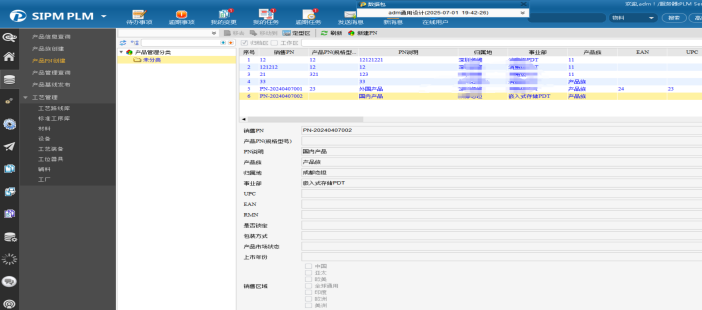
Manage product data by organizing it according to product families, product part numbers (PNs), and product categories. The system also supports product baseline releases, enabling effective traceability of key milestones throughout the product development lifecycle.
_1772784565733.png)
_1772785183575.png)
_1772785418591.png)
Firmware Material Management:
Provides basic management of software release packages, software program packages, firmware materials, and equipment-related software materials.
_1772785770869.png)
_1772785836138.png)
_1772786293581.png)
_1772786741106.png)
Schematic Management:
【1】When the schematic design is completed and a matching PLM design component list is submitted at the interface, if it is found that the PLM system lacks the components needed by the engineer, it is necessary to first apply for new components before proceeding with the schematic design.
【2】The process for applying for new components is as follows: A: Create a new component; B: Obtain a code and fill in the component attributes; C: Submit the process for review to generate a new component, including updates to the design component list (category, parameters, brief description).
_1772787029805.png)
_1772787633854.png)
_1772788012196.png)
Drawing and Document Management
By implementing the PLM system’s drawing and document management module, the company has achieved centralized control over its engineering drawings and documents, along with objectives such as categorized searching, version tracking and retrieval, access control and data security, and real-time collaboration and sharing.
_1772788750155.png)
_1772788918163.png)
_1772789171823.png)
Product Mapping Management
By implementing the PLM system’s product mapping management functionality, the company achieves the objective of managing mappings and associations between its products and factories, customers, part numbers (PNs), and testing methods.
_1772789330161.png)
_1772789756686.png)
_1772789982954.png)
Custom Function Management
Through the implementation of customized PLM system features, the company has enhanced user experience and incorporated error-proofing mechanisms at a detailed level.
Material Approval Role Mapping Table: This reference table enables the material approval workflow to automatically assign standardization specialists based on material categories, ensuring the right personnel are involved according to predefined rules.
_1772790174808.png)
Technical Parameter Concatenation Rule Configuration: This reference table automatically concatenates different parameter attributes into the "Specification/Model Attribute" field based on the material's classification.
_1772790442636.png)
Critical Document Configuration for Key Materials: This reference table automatically verifies, based on material classification, that the required documents for each material have been uploaded, implementing error-proofing and control measures.
_1772790653427.png)
Automatic Component Version Upgrade Configuration: This reference table automatically checks attribute change information based on material classification, enabling validation for whether a version upgrade should be triggered or not.
_1772791155027.png)
Configuration of BOM Assemblies and Key Sub-components: This reference table automatically verifies, based on the classification of the BOM assembly material, whether the corresponding key sub-components are included in its BOM, thereby implementing error-proofing and control measures.
_1772792285891.png)
Standardize and Institutionalize the Change Management Process,Standardize and solidify the change management process to ensure full traceability of all technical data.
Implement a structured, task-driven approach to change management, enabling effective tracking and control of all changes. Additionally, leverage SIPM/PLM’s powerful query tools to monitor all engineering change activities in real time and maintain a complete, auditable history of changes for all company products.
_1772792459498.png)
Summary
Through the successful implementation of the PLM system, Shenzhen Biwin has significantly enhanced its product management capabilities and improved the overall management of design and R&D processes. By integrating structural design software with the PLM system, the company has ensured standardization and consistency of product design data.This implementation has progressively increased both product management efficiency and R&D productivity, improved design quality, and reduced product development costs. Data confidentiality has also been strengthened.Biwin has now achieved end-to-end centralized online management across the entire design process—from requirements, projects, and products to design, materials, drawings, and documents—enabling engineers to quickly retrieve data and substantially boosting their work efficiency.With the continued application of these modules, the PLM system will evolve into a unified collaborative management platform spanning all departments across the company.